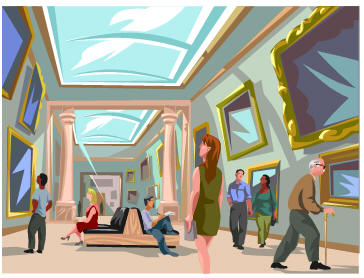
The Museum as Educator
More
and more art museums have assumed the role of educator and are very
involved
in docent in the school programs, art schools, classes for teachers,
and as
an important resource for the classroom teacher. There are a number
of
museums who have an art expert service over the internet. Museums will
provide
volunteers to visit your classroom, and often provide slide &
educational supplements for current and permanent exhibitions. The museum
stores
often have additional educational materials available to the teacher.
The
National Gallery of Art located at
http://www.nga.gov has a wealth of
resources for K-12 teachers. Available to teachers is also a hardcopy catalog
of the
National Gallery of Art will loan films, slides and other materials to
teachers. Contact the gallery for a catalog and rules.
Department of Education Resources
Education Division
National
Gallery of Art
4th and
Constitution Ave, N.W.
Washington D.C. 20565
National Gallery of Art-Classroom
http://www.nga.gov/education/classroom/
Links to Art Museums selected by Teachers. Take a look at the art lessons and art resources for teachers at the art museums listed.
Visit your local gallery and ask to speak to the Educational curator about field trips and other resources for teachers.
How to visit an art gallery with children. Here are some suggestions that I have written regarding visiting the art museums with children.
BEFORE VISITING THE MUSEUM
1.
Call the museum ahead of time to find out who is the featured
artist. Most museums also have an ongoing permanent collection.
Find out the hours the exhibition
will be opened, the price of admission,
and if there
is a docent (art guide) available for children oriented
tours. Sometimes it is possible, during the weekdays to join a
school tour
lead by the educational department. Find out if there
are special materials available for your child to receive when
they arrive at the museum.
2. Research the artist/artists featured and find a comparable
children's book that will introduce your child/student to the
exhibition. Call the educational department of the museum and
ask to speak to the educational curator. Ask them if there are
materials available
for you to review or receive that will explain art
through a child's perceptive.
3.
Purchase a few postcards ahead of time or buy a catalog of the
show. Children, like adults, are excited to see something that
they have been introduced to ahead of time. You can create a
game of "where are the paintings you know." The child will be
surprised, delighted, and bursting with self-esteem when they
recognize the painting, the title and artist.
4. Explain
the rules of the museum to the child beforehand so that
they will
have an enjoyable experience at the museum and will not
have to be reminded by a guard not to touch the artworks.
5. Make
the visit short. A museum can be too much of a good thing,
especially the first visit.
6.
Ask the child ahead of time to choose a favorite work of art.
7. Ask the museum about taking photographs, or video. Most
museums will allow non flash photos and most all will allow non-
commercial
video of their own collections. You will probably not
be able to photograph visiting shows. Often you can purchase
a postcard of most works in permanent collections.
AT THE MUSEUM
1.
Meet and introduce the child to the docent if you have made
arrangements beforehand.
2. Remind your child to tell you when they discover the special
painting/paintings that they chose before coming to the museum.
3. When looking at individual paintings or works of art, ask
the child to imagine that they were describing the artwork to
someone who had never seen the artwork. Ask them to look and
name everything that they see in the composition. Remind them
that there is also information about the painting in written
form on the
wall. They will be able to find out the title, artist,
nationality of artist, medium, of the artworks.
4. Next
ask them to name the lines that they see. Do they see any
horizontal lines. Do they see vertical lines? etc.
What about
the colors. Do they see warm colors-like red fire, or
a yellow sunny color, or orange colors like a volcano erupting?
Do they
see cool colors-like a blue fresh sky, or green grass, or
violet (purple) cold ice? Are the people or objects low on the
compositional plane?
Does that placement make them look closer to us?
Are the figures or objects in the background blurry? Does that
create a feeling of being far away. Ask them about textures?
Is the surface of the composition smooth, or coarse, or shiny,
or dull?
Are there round shapes, or square shapes, or triangular
shapes in the composition?
5.
Ask the child if they see a story being told in the painting.
Does the painting tell them something about people from another
time? Does the artist let us make up our own story? What might
the people
be doing or saying to each other? What is the weather
like in the artwork? What time of year is it? What country
is
presented? What kinds of clothing is being worn? Is the artist
paying tribute to a group of people? Is the artist telling us
about the suffering or injustice that the artist sees around
the world? Is the artist showing us nature? or beauty?
or
making a religious statement?
AFTER THE MUSEUM VISIT
1.
Ask the child to write a short letter about one painting that
they saw at the museum. Ask them to describe this painting so
that the
person they are writing to might get a mind's eye view of
the artwork.
2. Look at the
postcard and ask the child to compare the differences
between the
real painting and the postcard version. Does seeing the
real colors,
and textures, and size contribute more to the enjoyment
and understanding of the artwork?
3. After printing the information below, ask the child to
circle the following lines, colors, textures,
space, and shapes that they find in this particular painting.
Line-vertical,
horizontal, zigzag, wavy, curving, flowing, broken
Do the
horizontal lines create a peaceful feeling in the painting?
What about the zigzag lines? or the broken ones. What kind of
mood do they
create? As the child to think of and draw 5 more lines
that an artist might use to create an artwork.
Color-primary
colors (red, yellow, blue), warm colors (red, yellow,
orange), cool colors (blue, green violet), complementary colors
(colors which are
opposite one another on the color wheel), analogous
colors (colors which
are side-by-side, or adjacent on the color wheel.
How do the colors effect
the mood or feel of the painting. Complement-
ary colors
create a sense of excitement, whereas analogous colors
create a mood of calmness and peace.
Space-deep, shallow,
flat, volumesque, empty space. Where are you,
the viewer,
in relationship to the painting? Has the artist used
overlapping,
placement, one-point perspective, aerial perspective,
or color relationships to create a sense of space in the the
painting or artwork.
Texture-matte,
dull, shiny, coarse, feather-like, fuzzy. Texture
can be seen as well as felt. Texture is the amount of surface
light
seen in the artwork. A dull surface give a different meaning
to an
artwork than a bright surface does. Ask the child to discuss
the influence that texture and the other elements of composition
(line, texture, space, color, and shape) have on the meaning of
the artwork.
Shape-rounded,
square, biomorphic (thoses shapes found in nature),
triangular,
pyramidal, cylindrical. Ask the child to imagine that
the painting
was a theatrical stage set. Would the shapes be easily
cut-out to form paper-doll like figures or are they blended and
more painterly.
Are the figures or objects stiff and unyielding or
are they soft and diffused.
4. Encourage the child to
create a story about what the artist is saying
to the viewer.
5. Encourage the child to
create a painting, collage, or sculpture of the
artwork before reviewing the postcard.
6. Suggest that
the child select just one part of the painting and
magnify it with their imagination and then draw it.
7. Draw or paint the artwork and then cut and paste it onto a
cardboard to create a puzzle.
8. Encourage the child to explore the elements of composition
by participating in exercises that reinforce their understanding
of line, texture, space, color, and shape.
9. Plan another visit to the museum soon.
Art Teacher on the Net (c) 1997-2012
Before the Museum Visit
Share the biographies and art work of artists who have experienced physical and emotional challenges. For instance, Henri Matisse created some of his most famous paper cut-outs from a wheelchair. The brushes of Auguste Renoir were tied to his hands to enable him to paint some of his most memorable work due to crippling arthritis. One of the most important pioneers of modern art-Vincent van Gogh-suffered from epilepsy, and emotional illness. The list of physically and emotional artists who contributed to the history of art is long.
Call the museum beforehand to inquire about programs for special needs students. The museum may be able to contact local experts or a museum volunteer that specializes and understands the needs of your child or student. Arrangements for preparing the environment (making necessary equipment and space considerations) to enhance your child's visit can also be made at that time. Help the museum to understand what your child/student will need. Don't assume they know.
Contact volunteer organizations that specialize in special needs program. Ask if a volunteer is available for advice or to accompany the tour.
Contact the special needs teachers in your school district to find out if they have suggestions for creating the best possible museum experience.
At the Museum
As a teacher/guide be sure to include everyone. Speak directly to students who are physically or emotionally challenged-include everyone in an interactive positive experience.
Remember the power of words. For instance, "Matisse created from his wheelchair," is a more honest and positive statement then, "Matisse was confined to his wheelchair."
As a museum guide create interaction and
interest in your group. Although it is important for students to
understand that museum paintings can not be touched, the elements of
composition-texture for instance can be experienced first hand, by creating a
touchable piece that can be shared and passed amongst the group. This is
especially true for visually impaired students. In fact, there are now
art exhibitions especially created for visually impaired visitors. There
are also audio guides that are specifically designed for visually impaired
visitors.
Use objects that relate directly to the
painting you are discussing.
As a museum guide create a clear descriptive presentation. Be certain that your presentation is clear, and creates a "mind's eye picture".
Utilize all the senses in your
presentation. Let students experience the "sound" of an environmental
installation piece, or the "feel and form" of sculpture. There are even
artists who incorporate taste, as a "medium"
into conceptual works.
Listen to comments, verbal and non-verbal that will give you clues to students interests and needs.
Most of all create a fun and educational environment that children will want to return again.
After the Museum Visit
Ask students to share their experience. Talk about it. What did they find most enjoyable? Listen closely, to discover what they most enjoyed "doing".
Create art projects that reinforce concepts learned at the museum.
Display your child/student's artwork with pride and look for opportunities to display their work in neighborhood exhibitions, the internet exhibits for children, and other special events.
Explore a variety of museums that emphasize participation including children's museums, interactive art installations, sculpture gardens, etc.
All Rights Reserved
1999-2012